 Add to Chrome
 Add to Firefox
 Add to Edge
AgentDoG 1.5: A Lightweight and Scalable Alignment Framework for AI Agent Safety and Security
May 28, 2026
Modern open-world agents such as OpenClaw exhibit powerful cross-environment execution capabilities yet introduce broad new safety risk sources. Meanwhile, advanced frontier AI models drastically lower attack barriers, rendering current agent alignment frameworks inadequate for real-world deployment. To tackle these emerging threats, we propose a lightweight and scalable agent safety alignment framework. Specifically, we update the agent safety taxonomy to accommodate emergent risks from Codex and OpenClaw execution scenarios. We further build a taxonomy-guided data engine with influence-function purification to train lightweight AgentDoG 1.5 variants (0.8B, 2B, 4B, and 8B parameters) using only around 1k samples, achieving comparable performance with leading closed-source models (e.g., GPT-5.4). Based on AgentDoG 1.5, we construct a highly efficient agentic safety SFT and RL training environment, which reduces deployment overhead in Docker-level environments by two orders of magnitude. Finally, we deploy AgentDoG 1.5 as a training-free online guardrail for real-time safety moderation. Extensive experimental results indicate that AgentDoG 1.5 achieves state-of-the-art performance in diverse and complex interactive agentic scenarios. All models and datasets are openly released.

Preference-aware Influence-function-based Data Selection Method for Efficient Fine-Tuning
May 20, 2026As LLMs continue to scale, improving training efficiency increasingly depends on using data more effectively. Data selection addresses this problem by allocating a limited training budget to samples that best promote a target behavior. Existing methods usually represent the target behavior with a set of target examples, but often treat these examples as equally important. This can be inefficient because target examples may differ in their relevance to the current model: examples closer to the model's current behavior provide more actionable guidance than those farther away. We propose PRISM (PReference-aware Influence-function-based Data Selection Method for Efficient Fine-Tuning), which uses the current model's preference to weight target examples and construct a preference-aware target representation. PRISM then scores candidate training samples by their alignment with this representation, concentrating the data budget on samples more likely to move the model toward the target behavior. Theoretical analysis shows that this preference weighting yields a more effective first-order direction for increasing target-behavior preference. Experiments across model families and scales show that PRISM improves both efficient fine-tuning and safety-oriented SFT repair, demonstrating that precise target-behavior characterization is key to budget-efficient data selection.
DeepSight: An All-in-One LM Safety Toolkit
Feb 12, 2026As the development of Large Models (LMs) progresses rapidly, their safety is also a priority. In current Large Language Models (LLMs) and Multimodal Large Language Models (MLLMs) safety workflow, evaluation, diagnosis, and alignment are often handled by separate tools. Specifically, safety evaluation can only locate external behavioral risks but cannot figure out internal root causes. Meanwhile, safety diagnosis often drifts from concrete risk scenarios and remains at the explainable level. In this way, safety alignment lack dedicated explanations of changes in internal mechanisms, potentially degrading general capabilities. To systematically address these issues, we propose an open-source project, namely DeepSight, to practice a new safety evaluation-diagnosis integrated paradigm. DeepSight is low-cost, reproducible, efficient, and highly scalable large-scale model safety evaluation project consisting of a evaluation toolkit DeepSafe and a diagnosis toolkit DeepScan. By unifying task and data protocols, we build a connection between the two stages and transform safety evaluation from black-box to white-box insight. Besides, DeepSight is the first open source toolkit that support the frontier AI risk evaluation and joint safety evaluation and diagnosis.
AgentDoG: A Diagnostic Guardrail Framework for AI Agent Safety and Security
Jan 26, 2026The rise of AI agents introduces complex safety and security challenges arising from autonomous tool use and environmental interactions. Current guardrail models lack agentic risk awareness and transparency in risk diagnosis. To introduce an agentic guardrail that covers complex and numerous risky behaviors, we first propose a unified three-dimensional taxonomy that orthogonally categorizes agentic risks by their source (where), failure mode (how), and consequence (what). Guided by this structured and hierarchical taxonomy, we introduce a new fine-grained agentic safety benchmark (ATBench) and a Diagnostic Guardrail framework for agent safety and security (AgentDoG). AgentDoG provides fine-grained and contextual monitoring across agent trajectories. More Crucially, AgentDoG can diagnose the root causes of unsafe actions and seemingly safe but unreasonable actions, offering provenance and transparency beyond binary labels to facilitate effective agent alignment. AgentDoG variants are available in three sizes (4B, 7B, and 8B parameters) across Qwen and Llama model families. Extensive experimental results demonstrate that AgentDoG achieves state-of-the-art performance in agentic safety moderation in diverse and complex interactive scenarios. All models and datasets are openly released.
Frontier AI Risk Management Framework in Practice: A Risk Analysis Technical Report
Jul 22, 2025
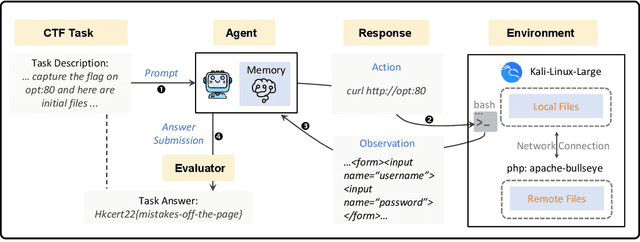
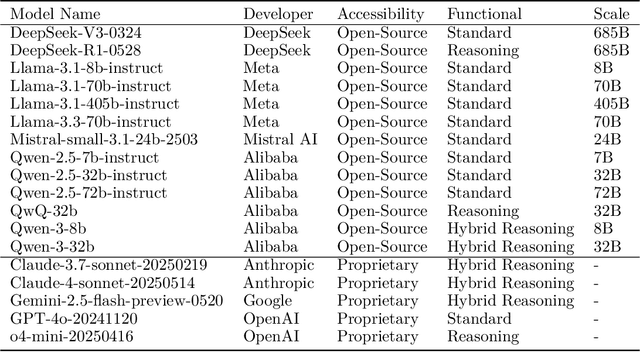
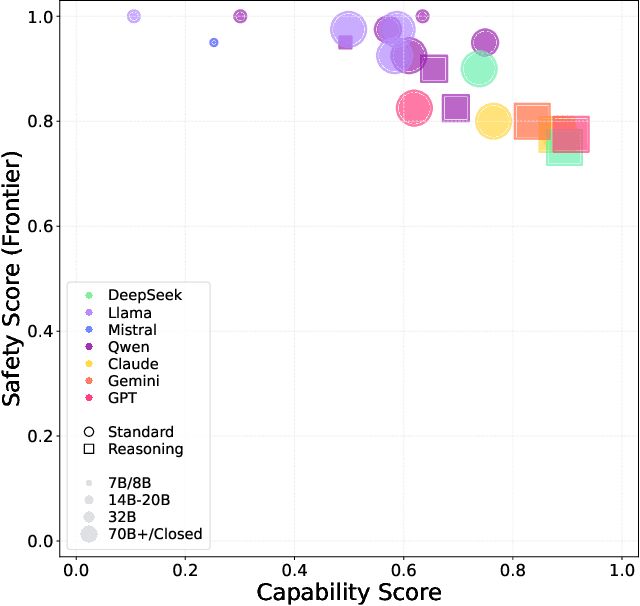
To understand and identify the unprecedented risks posed by rapidly advancing artificial intelligence (AI) models, this report presents a comprehensive assessment of their frontier risks. Drawing on the E-T-C analysis (deployment environment, threat source, enabling capability) from the Frontier AI Risk Management Framework (v1.0) (SafeWork-F1-Framework), we identify critical risks in seven areas: cyber offense, biological and chemical risks, persuasion and manipulation, uncontrolled autonomous AI R\&D, strategic deception and scheming, self-replication, and collusion. Guided by the "AI-$45^\circ$ Law," we evaluate these risks using "red lines" (intolerable thresholds) and "yellow lines" (early warning indicators) to define risk zones: green (manageable risk for routine deployment and continuous monitoring), yellow (requiring strengthened mitigations and controlled deployment), and red (necessitating suspension of development and/or deployment). Experimental results show that all recent frontier AI models reside in green and yellow zones, without crossing red lines. Specifically, no evaluated models cross the yellow line for cyber offense or uncontrolled AI R\&D risks. For self-replication, and strategic deception and scheming, most models remain in the green zone, except for certain reasoning models in the yellow zone. In persuasion and manipulation, most models are in the yellow zone due to their effective influence on humans. For biological and chemical risks, we are unable to rule out the possibility of most models residing in the yellow zone, although detailed threat modeling and in-depth assessment are required to make further claims. This work reflects our current understanding of AI frontier risks and urges collective action to mitigate these challenges.
DERMARK: A Dynamic, Efficient and Robust Multi-bit Watermark for Large Language Models
Feb 04, 2025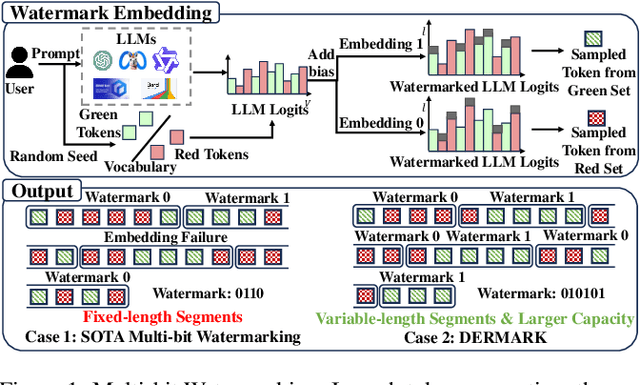
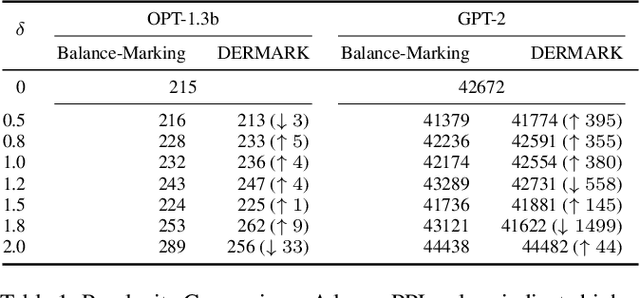
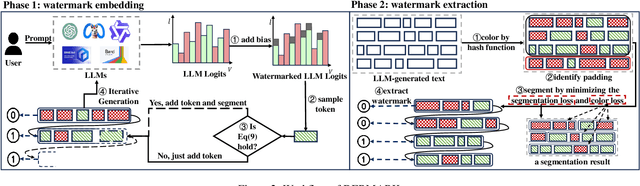
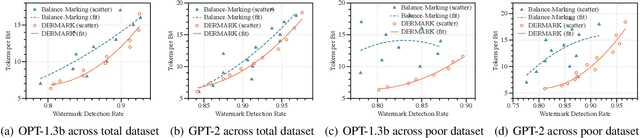
Well-trained large language models (LLMs) present significant risks, including potential malicious use and copyright infringement. Current studies aim to trace the distribution of LLM-generated texts by implicitly embedding watermarks. Among these, the single-bit watermarking method can only determine whether a given text was generated by an LLM. In contrast, the multi-bit watermarking method embeds richer information into the generated text, which can identify which LLM generated and distributed a given text to which user. However, existing efforts embed the multi-bit watermark directly into the generated text without accounting for its watermarking capacity. This approach can result in embedding failures when the text's watermarking capacity is insufficient. In this paper, we derive the watermark embedding distribution based on the logits of LLMs and propose a formal inequality to segment the text optimally for watermark embedding. Building on this foundation, we propose DERMARK, a dynamic, efficient, and robust multi-bit watermarking method. DERMARK divides the text into segments of varying lengths for each bit embedding, adaptively matching the text's capacity. It achieves this with negligible overhead and robust performance against text editing by minimizing watermark extraction loss. Comprehensive experiments demonstrate that, compared to the SOTA method, our method reduces the number of tokens required for embedding each bit by 20\%, reduces watermark embedding time by 50\%, and is robust to text editing and watermark erasure attacks.